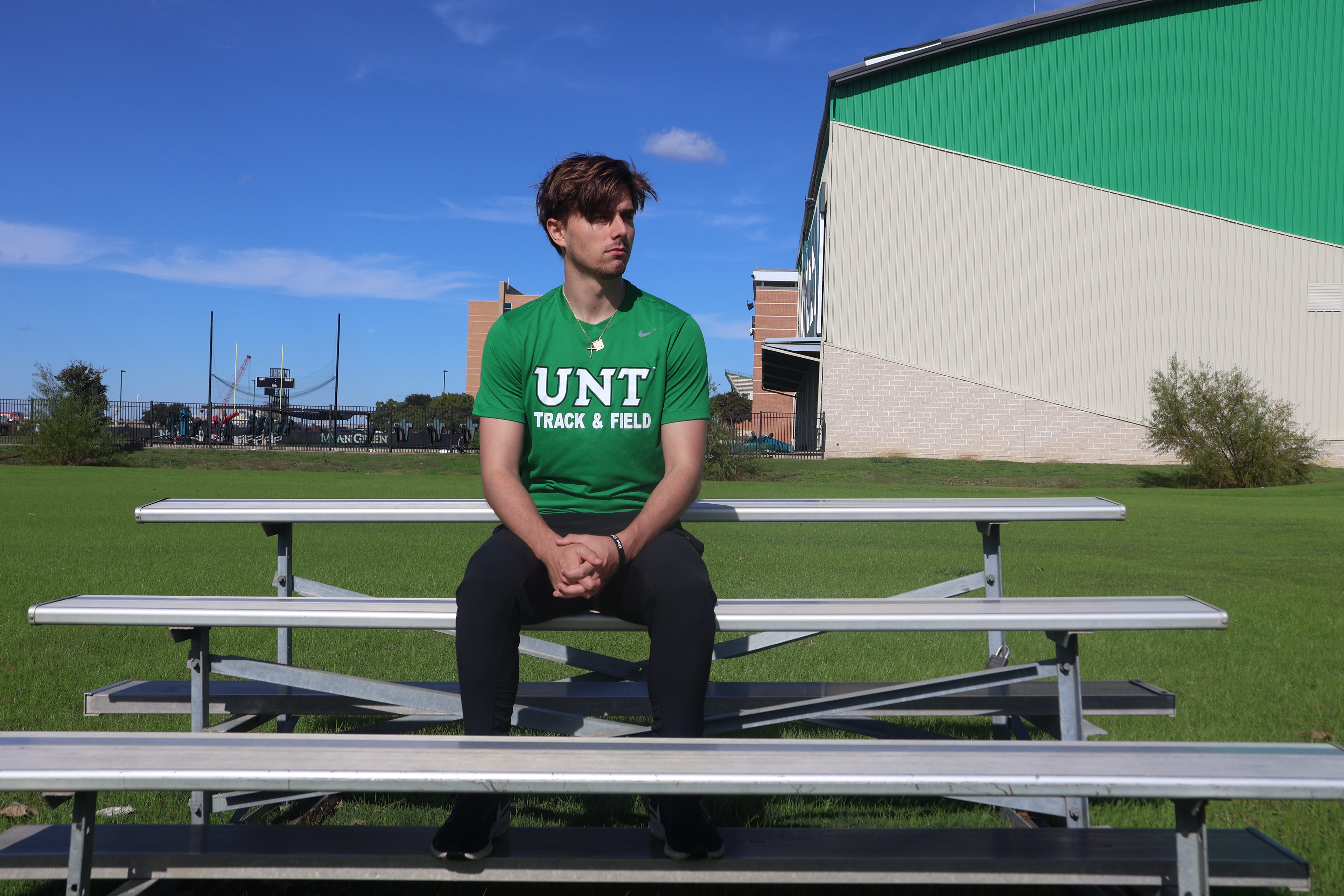
Damian Wells sits on the bleachers at the University of North Texas track and field practice. Cynthia Garcia
Sitting in an isolated dorm room was the norm for college freshman track and field athlete Damian Wells when he attended the University of North Texas. Wells said he would sit in his dorm for long hours carrying the heavy weight of depression and anxiety.
Although he was surrounded by friends, he didn't reach out to anyone because he was in denial. Instead, he relied on drinking alcohol to try to feel something.
But eventually the weight of anxiety and depression overcame him, and on Oct.1, 2021, he reached his lowest point: he tried to take his own life.
It was Friday evening when Wells had just finished taking his Calculus 2 exam in his dorm room, Clark 316. Once the low score of the exam appeared on his screen, he started to feel enclosed, and the weighted blanket of anxiety and depression came in all at once.
He decided to take a walk, and he turned left near Clark Hall to go to the pedestrian bridge. As he was walking, he felt the blanket was getting heavier by the second. Once he arrived at the bridge, he kept pacing back and forth and after a while he decided to stand on one of the pillars, he recalled.
He looked out onto the highway and although he heard the city noises around him, he felt like he was in a trance. The thoughts that he should jump started to roll in his mind. He set his phone down so that no one could track him.
Suddenly, his phone ringer went off and a text from one of his teammates appeared on the screen. That woke him up and he realized where he was and what he almost did.
Wells is one of the thousands of college male athletes facing anxiety and depression. About 31% of male NCAA student-athletes reported symptoms of depression or anxiety in both the 2008 and 2012 academic years, according to National College Health Assessment data.
Athletic identity plays a crucial role in contributing to self-worth and anxiety among male student-athletes, said Caleb Wilborn, a UNT sports psychology consultant. Research shows when athletes place too much importance on their athletic identity and that identity becomes at risk, problems arise.
“An individual who has over-identified with their athletic identity may suffer from increased mental health concerns or mental performance concerns if their athletic identity is threatened,” Wilborn said.
When Wells first started running track in college, he had an unhealthy relationships with his athletic identity, he said, recalling he was a “slave” to his sport during his first two years.
That unhealthy relationship with his athletic identity created self-made pressure, lowered his self-esteem, and ultimately contributed to his anxiety and depression. He recalled he had an unhealthy relationship with the seconds and minutes on the stopwatch, becoming obsessed with beating his times and constantly comparing himself to other athletes’ performances.
“For me, my performance and how I ran truly dictated how I was around other people, because I was so competitive to the point where I made myself and my performance way above what I was as a human being,” Wells said.
Wells began using the UNT sports psychology resources during his sophomore year. He started therapy about two to three weeks before publicly sharing his experiences with his teammates in October 2022. During his junior year, after going on a mission trip, he deepened his connection to Christianity, furthering his spiritual growth. This journey inspired him to work with young athletes, and today he serves as a representative for the Greater Denton Fellowship of Christian Athletes.
Athletes who strongly tie their identity to their performance often place intense pressure on themselves, which leads to a continued cycle of anxiety, Wilborn said.
Before Luke Calcatera became the head men’s golf coach at UNT, he was an athlete at Arkansas Tech University, where, he said, his performance outcome defined his value. Now he tries to tell his athletes that performance doesn’t define who they are. A coach’s role is important in shaping and supporting athletes.
“We really try and communicate that how you play, your success and your failure doesn't reflect who you are as a person and trying to not have those things connected,” Calcatera said.
Pressure affects athletes in many different ways. For some athletes, the self-pressure to always beat the number on the stopwatch can come from the pressure of maintaining their athletic scholarship. Athletes feel they have to meet certain numbers to succeed.
“Then they're forcing, just movements and things like that, just the overall to try to hit certain numbers, to try to maintain whatever they're on,” UNT head track and field coach Doug Marshall said.
Wilborn explained that there’s a stigma around mental health about what a male athlete should be, how he should speak, and how he should express or hide his emotions.
“They're often less likely to come in and to seek help and support in those ways, which can lead to a lot of feelings of disconnection from others, isolation, withdrawal tendencies, all of those sorts of things that that are not uncommon or new, but they just look a lot different for athletes,” Wilborn said.
Despite the stigma that still exists for male athletes, as a former young male athlete who was constantly surrounded by the toughness of older men, assistant track and field coach Marco Brown emphasizes how building relationship with athletes improves team morale.
“Sometimes we have to pull it out of them, because they don't want to come off as weak,” Brown said. “Telling them you love them, and letting them know that I'm here for you, and saying those things and doing it through the acts of servant leadership … then there's an understanding.”
Although stigma and toxic masculinity are still a challenge for male athletes, more male athletes are communicating with others to seek help.
“I would say it's more of a challenge now, but they're also more willing to see people than they were in the past, where in the past, it could just kind of get buried,” Calcatera said. “Now I think male student athletes are still better at communicating it or using resources to have people help them.”

Cynthia Garcia is a Mayborn School of Journalism student majoring in print and digital media with a minor in Spanish. She currently works as a part-time reporter for the The Azle News and the The Springtown Epigraph, where she covers community events and feature stories. She is set to graduate in Spring 2026 and hopes to become a reporter for a Spanish-language newspaper, using her work to amplify underrepresented voices.