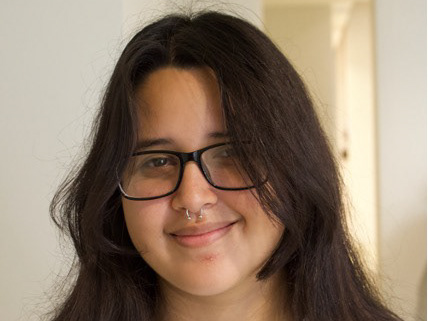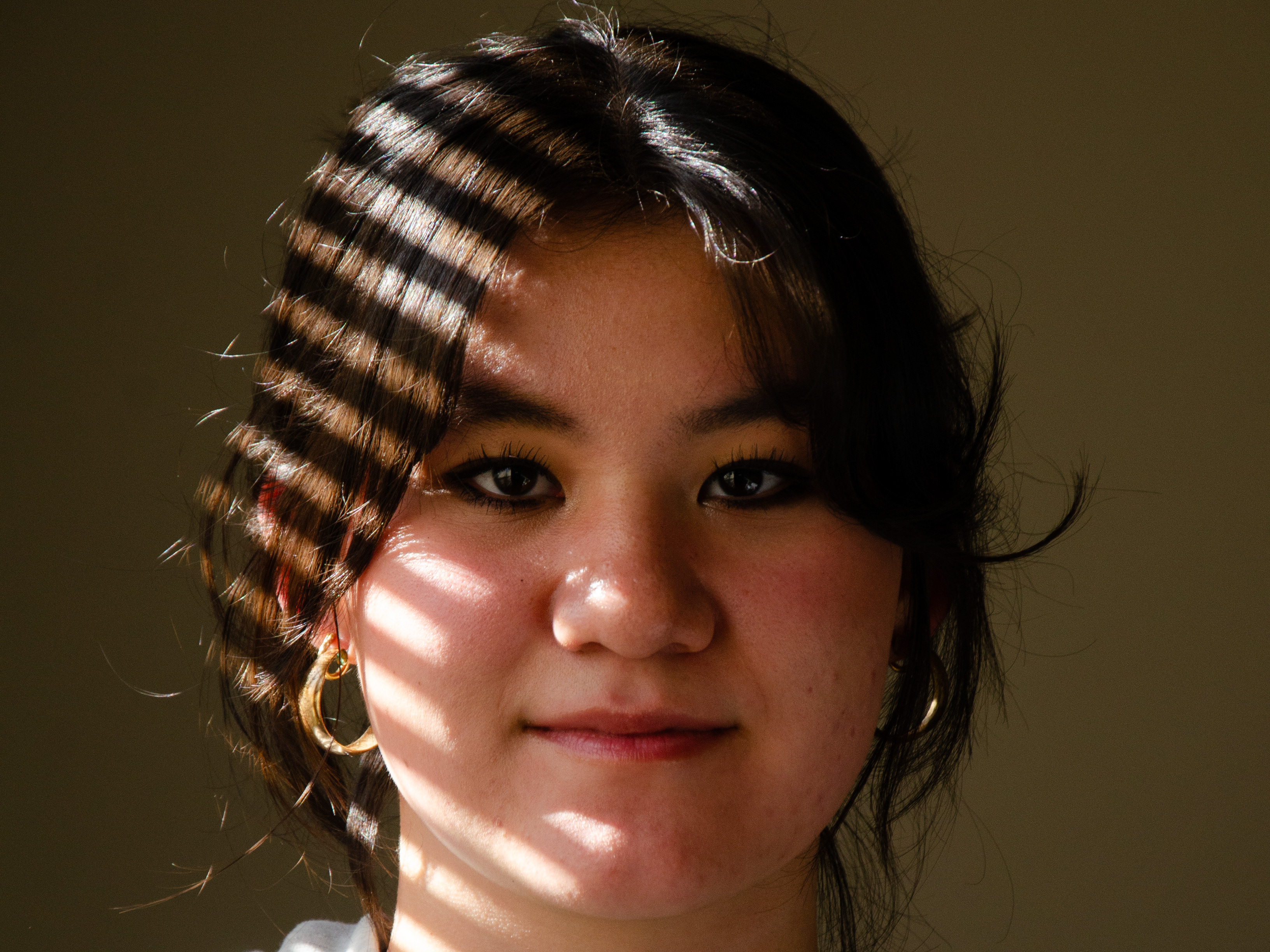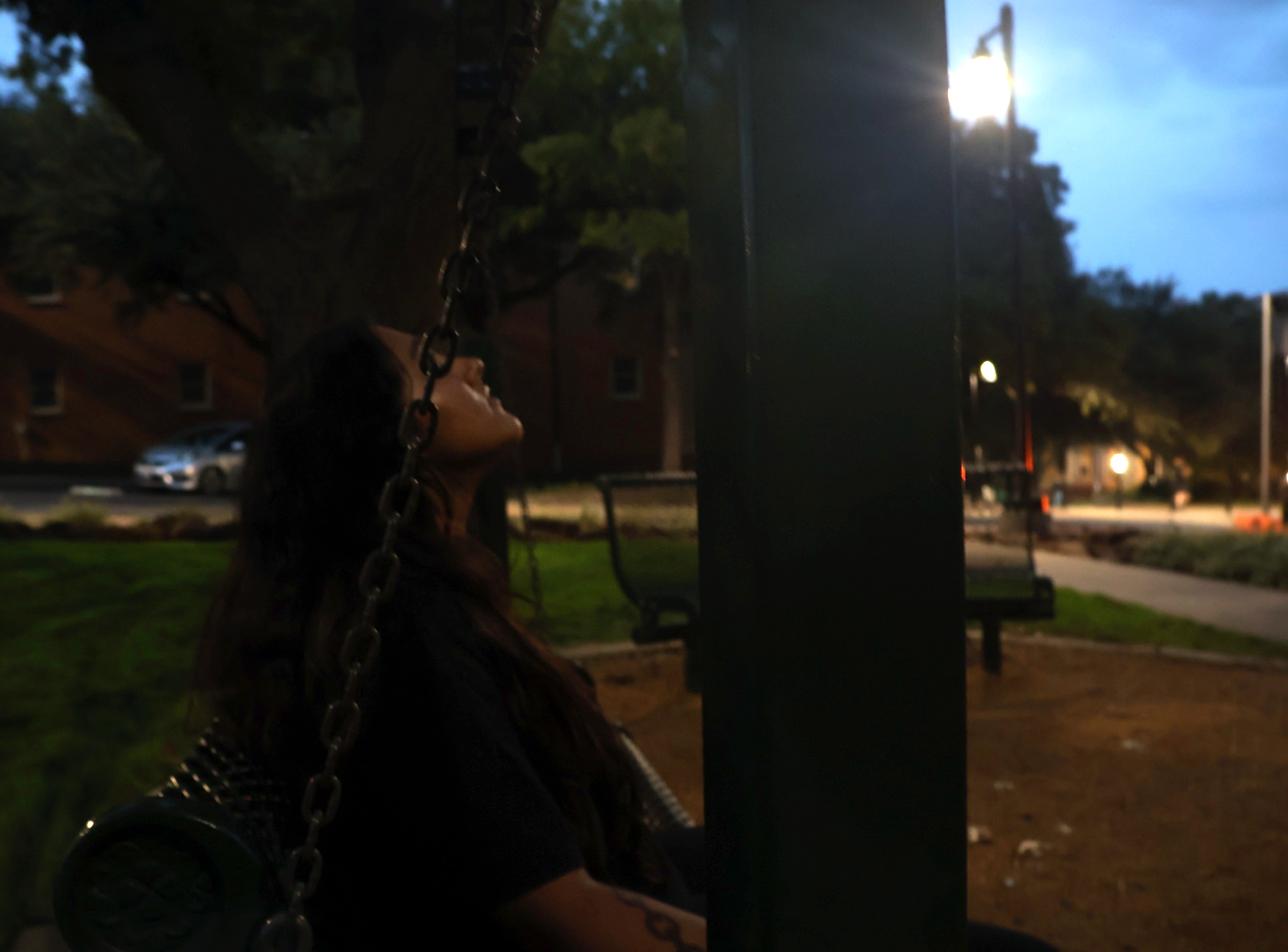
Liberty sitting on a swing in front of the Hurley Administration on Tuesday, Nov. 18, 2025. Eliana Fulton
The immigration officer stared down at Destiny as she approached the desk with her carry-on luggage and a handful of physical documents. The officer eyed the young, practicing Muslim woman, scanning her hijab as if it were a weapon. She nervously presented her passport and evidence of her acceptance to the University of North Texas.
The officer questioned her incessantly, and she was eventually escorted to a side room where she watched several people enter, show their passports and leave.
“I was anxious and nervous because I’m travelling for the first time alone internationally,” she said. “I knew nobody there. I didn’t know the consequences, but in my head, I had another thing going.”
Destiny considered the worst-case scenario. Everything her parents had funded, and all her efforts to get into UNT would be wasted because she might have to return to India. When she was finally released, she had missed her connecting flight to Texas and waited another six hours for the next flight. Little did she know, this would be taste of a much longer season of uncertainty about her status as an international student.
Destiny is a pseudonym for a graduate international student who shared her experience but has chosen to stay anonymous for fear of a change to visa laws that could revoke her status.
On the pavements of colleges across the U.S. millions of international students travel from class to class. They study for tests, talk to their friends and push themselves to excel in their degree programs. As the political climate shifts to oppose international students, they face an influx of rapidly changing policies that cause fear and confusion.
Most recently, the Department of Homeland Security terminated at least 30 UNT international students’ Student and Exchange Visitor Information System (SEVIS) files. Those affected were primarily students who benefitted from the Texas Dream Act, according to an open letter to the North Texas Daily from the American Association of University Professors.
“When you see all of these really arbitrary policies that violate people’s rights to due process, and that limit freedom of speech and academic freedom you start seeing that people are less interested in coming here,” faculty member Altiok Ozelm said.
Ozlem was an international student herself when she first came to the U.S. She recalled that even after 9/11, when she started her college career, there was not as high a level of uncertainty about visa security as students have now.
Ozlem said many international students recently received a letter asking them to leave within 90 days. Although many of the visa revocations and SEVIS terminations were reversed, there were students that had packed up what they could, sold their possessions and moved back to their home countries.
Destiny said she and her friends discuss these issues constantly.
“We are really worried; we’re really scared,” Destiny said.
This process echoed across the nation. Many students were unable to finish their degree plans because their visas were revoked, and they watched as multiple semesters of work dissipated before their eyes. As both the DHS and Trump Administration continue to make changes to student visa requirements such as tax requirements, program restrictions and visa duration, international students say they are constantly reevaluating the legal terms of their visas.
Since fall 2024, international enrollment has declined, causing the university to budget for a $47.3 million loss in revenue according to the UNT 2026 Consolidated Operating Budget.
International students are only allowed to work on campus jobs, many of which pay low wages. This can add to the mental stress of these students, as they worry that the financial sacrifices that they and their family have made for their education will have been in vain.
“The fear of being deported or the fear of being an international person—I feel like it’s a thing almost every international student feels,” Liberty said. “It’s like a constant thought at the back of our minds.”
Upon Arrival
From the start of their college career, international students like Destiny have extra responsibilities that add to their mental load. The office of International Student services at UNT works to help student through programs like the International Advisory Student Board and the International Student Support Network, which are both student run, according to Liz Ford, senior director for International Student and Scholar Services. The department’s staff offers systematic guidance for everything from visas and legal services to advising and driver’s license workshops.
However, after legal adjustments, students also face extreme cultural changes. U.S. foods, social interactions and clothing styles leave students with a slew of undefined social adjustments.
“I only speak about mental health with my friends,” Destiny said. “Back in my country they are progressing, they are, but mental health is not a topic of concern yet.”
For this reason, many international students who struggle with mental health issues do not know how to pursue UNT’s or local mental health resources such as support groups or therapists.
Calvin Sims, a psychology professor of race, culture, and education, explained that many international students tell him that they can’t speak to their families about mental health concerns because they believe illnesses like depression are “just an American thing.”
One international student said that mental health is treated differently in the U.S.
She moved to the U.S. when her older sister started attending the UNT and attended Denton High School. This student has also chosen to stay anonymous for fear a threat to her visa status; the pseudonym Liberty will replace her name.
In high school, Liberty noticed that there were school shootings and other gun violence in Texas. She said her experience helped her understand why mental health care is a higher priority in the U.S. than in her home country, India.
Culture shocks, such as the one Liberty faced, can wear on international student’s mental health as they try to adapt to living in a new country.
Resources
Amid the stress of being in an unfamiliar country where they might have to practice a new language and learn new cultural rules, international students can experience mental strain.
While a study from the Public Library Online Services Mental Health journal found that non-citizen students experience some of the highest rates of mental health conditions, a study from the Psychiatry Services journal found that international student reported lower rates of treatment.
When UNT’s Counseling and Testing Services published data on its department in 2023, it found that graduate students utilize mental health services at “drastically lower rates” than other graduate students because international students were overrepresented in the survey.
Neither Destiny nor Liberty has made attempts to utilize UNT’s mental health facilities.
Many international students are unsure if sharing their personal information in a university therapy session could lead to legal consequences.
“A lot of folks are afraid that if they say something some federal agency then will find out about it and then I'll be in some type of trouble,” said Sims, the psychology professor.
Although Student Counseling Services can still provide individual sessions, legislation disbanding diversity, equity and inclusion programs prevent the center from organizing group therapy sessions around specific groups of diverse students.
“We do have a ton of other workshops and groups even though we’re not able to make them population specific, they still can be very beneficial to students in general,” Evans said.
UNT psychologists, both students and already licensed, are trained in cultural humility to mindfully respect students of diverse backgrounds and individualize sessions, Sims said.
Despite these mental health concerns, many international students, like Destiny and Liberty, continue to pursue their education.
Eliana Fulton is a freelance journalist based in Denton, Texas whose work has been published in the North Texas Daily. She also writes creatively and won the University Writing Award in Spring of 2025. Fulton is currently pursuing her Bachelor of Arts for Journalism and a Bachelor of Arts for English at the University of North Texas. She plans to work in editing and publishing for long form journalism projects after she graduates.