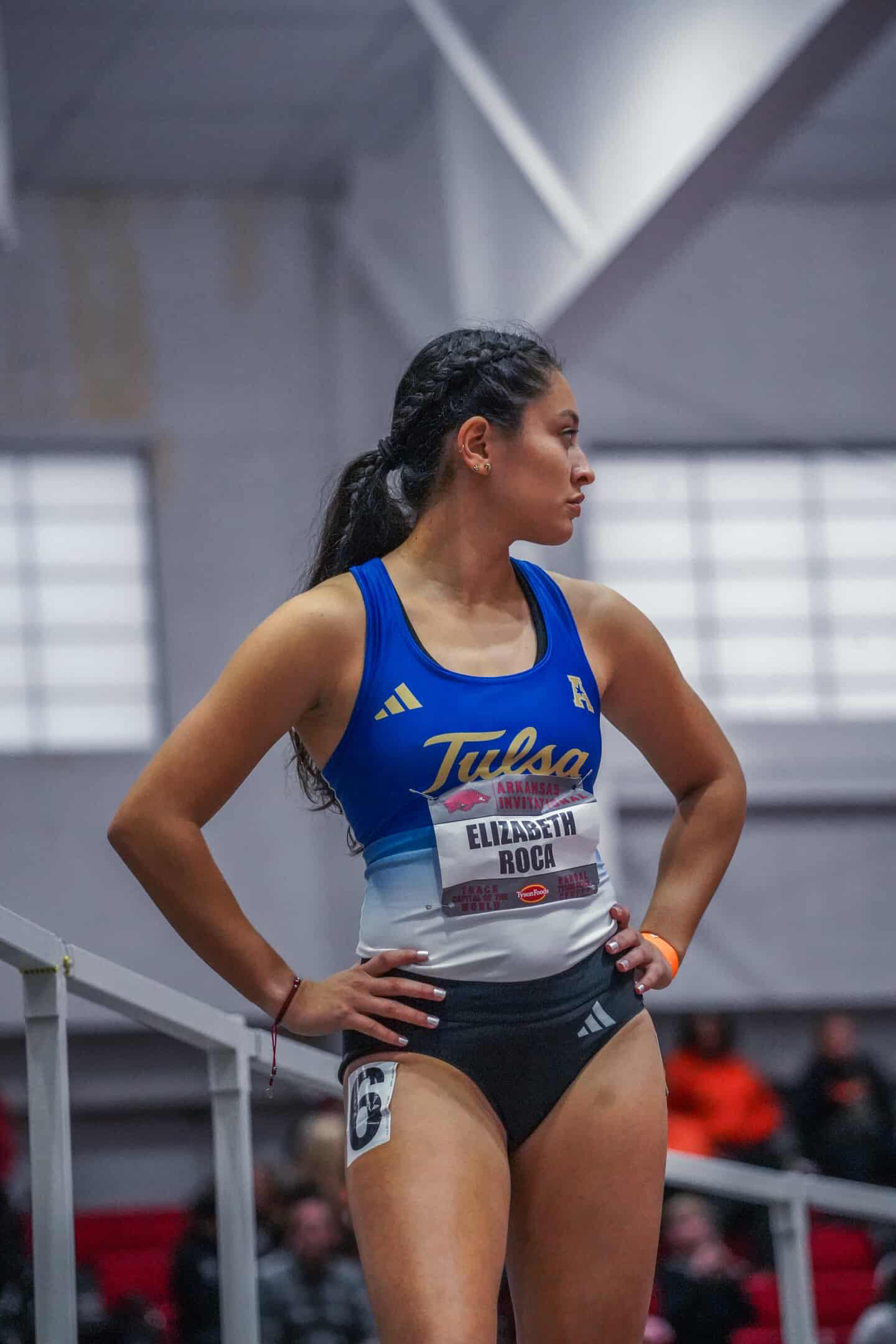
Elizabeth Roca competes at the 2024 Arkansas Invitational. Courtesy Tulsa Athletics
Narrow hips, broad shoulders and a muscular lower body.
This was Elizabeth Roca’s idea of perfection.
A four-year letterwinner at Leander High School, Roca committed to the University of Tulsa in 2020. A middle school track and field event 10 years prior sparked a passion that would eventually lead her seven hours from home. The fit was perfect for both her academic and athletic aspirations.
However, an internal struggle would soon become magnified as she entered a new environment.
“My freshman year of college it hit me like a truck,” Roca said. “Everything. My body looked different and I was living by myself.”
During her first year at Tulsa, she was affected by negative body image. Roca said she compared her body shape, size and appearance to those of other sprinters and perceived her lack of lower body muscle mass as a sign of inferiority. She was experiencing body dissatisfaction, a subcomponent of negative body image.
While the issue worsened in college, it wasn’t the first time she’d felt this.
“It started to actually bother me in high school,” said Roca, 23. “That’s when I started comparing myself to my teammates and competitors. It wasn’t as big of an issue because I was still winning.”
Roca’s sentiment is one that is shared globally by female college athletes, with universities such as the University of North Texas trying to pioneer change on campus and beyond. In the 1990s, UNT psychology professor Trent Petrie took notice of the trend and decided to create a program that would help diminish negative body image for female student-athletes.
By 2015, the idea would come to fruition in the form of the Bodies in Motion program, which has since been licensed to 25 different U.S. universities.
Claire Bailey, a program leader for Bodies in Motion at North Texas, acknowledged the risks that come with student-athletes having a negative relationship with their body appearance.
“Athletes have so many different things that they need to be focusing on during a competition,” Bailey said. “If your mind is taken over by, ‘I’m going to do this [swim] dive, how does my body look in this swimsuit?’ that can impact an athlete’s level of focus, concentration and confidence.”
The program, which operates under North Texas’ department of psychology, is comprised of five sessions with groups of four to eight female student-athletes for each session. The groups meet weekly for 75-90 minute discussion-based sessions, where group members practice what Bailey calls “mindful self-compassion” for empowerment.
“It’s a five-session structure, so each meeting has different goals and intentions behind it,” Bailey said. “But really, the overarching purpose is to help athletes grow more comfortable in who they are, their bodies as women and as athletes.”
In 2024, an NCAA study found that 45% of female student-athletes reported wanting to lose weight. In addition, the study revealed that fewer than 45% of women athletes agreed with positive body affirmations such as, “I think I have a good body” and “I am happy with my current weight”.
Female athletes came in 20-30 percentage points lower than male athletes on all measures of positive body image.
Though presented in the research as responses pertaining to athletics, the lasting effects of body image dissatisfaction for women and girls aren’t limited to sport-specific contexts.
“It can lead to increased risk of depression, anxiety disorder behaviors and potential clinical eating disorders,” Bailey said. “When athletes are having their mind taken over by body image concerns, that can impact all areas of functioning in terms of confidence as a person.”
A major influence on Roca’s perceived body image were the “bun” uniforms used among track and field athletes, which put female glutes and hamstrings on full display. Close in appearance to a bikini-style swimsuit, it’s a look that is optional to female athletes but not adopted by all. She watched teammates and competitors compete in the uniform, admiring from afar.
Her freshman year of college, Roca opted for the less revealing spandex shorts as she didn’t feel confident enough to wear the bun uniform.
“Seeing my teammates compete in the bun uniform, they always seemed to be cooler [and] they raced really well,” Roca said. “They seemed kind of like another group.”
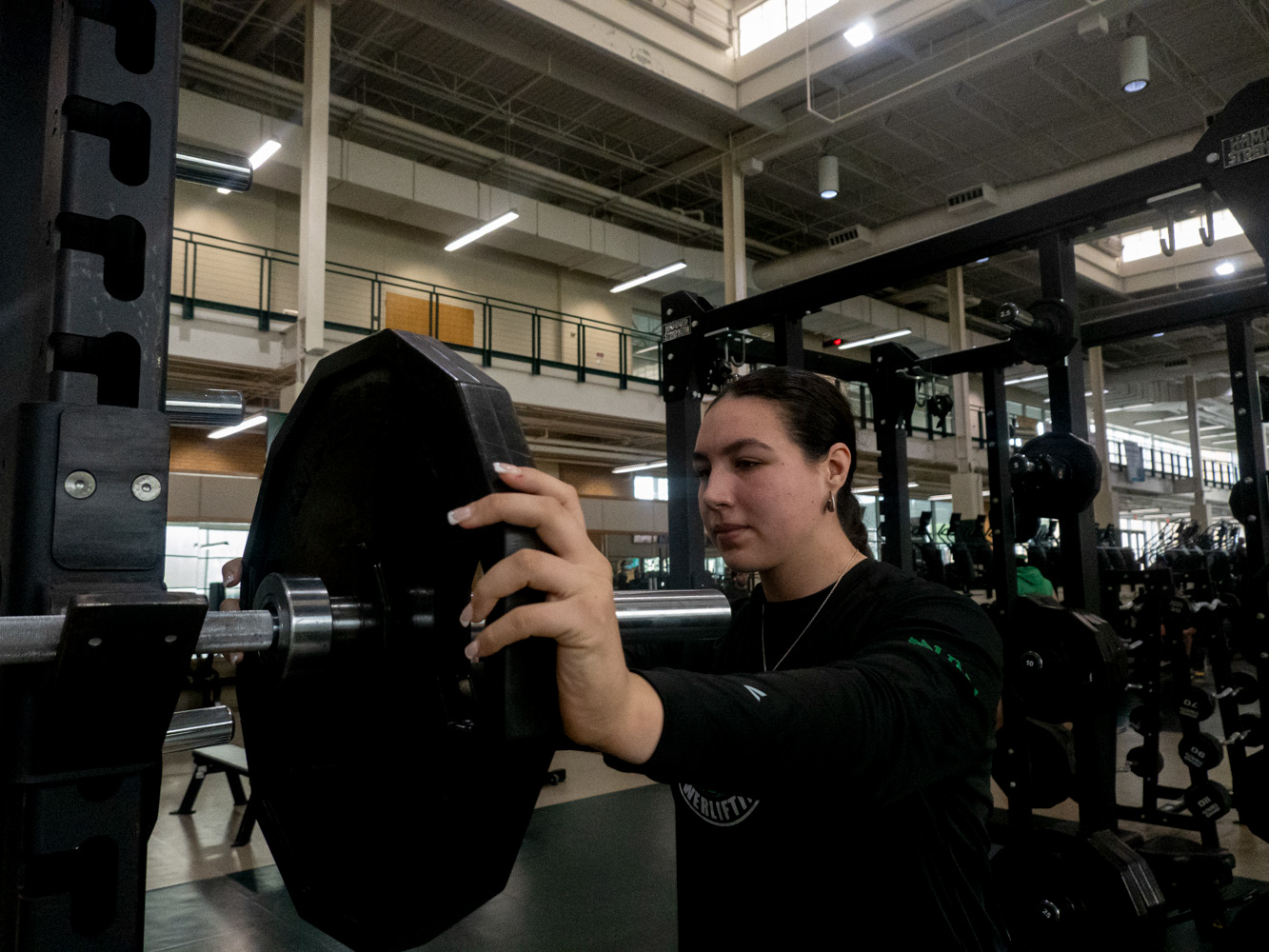
In an attempt to obtain her idea of perfection, she began training six days a week, with four days dedicated solely to weight training. She consulted the team’s nutritionist to create healthier eating habits, discarding even the smallest of snacks while seeking any path to improvement. It was the most training and preparation Roca had ever done in her life.
Still, she seemed to be gaining undesired weight and her negative emotions were carrying over into other aspects of her day-to-day life.
“It bordered [on] obsession,” Roca said. “[I was] overly critical and it just meant that I was way too distracted when it came to academics. I also feel like in an effort to become better, I wasn’t eating in the way I normally would.”
The Bodies in Motion program is based on cognitive dissonance theory, which is defined as a state of mental discomfort as a result of conflicting beliefs.
Methods implemented in the sessions include individual reflection as well as group sharing in order to increase awareness of what lies at the root of their emotions.
“Sometimes I feel like ‘mindfulness’ is one of those words where we hear it and it’s just like, ‘okay, what does that entail?’,” Bailey said. “In general and in this program, we’re referring to bringing awareness to what our thoughts and feelings are and really trying to connect back with what we are personally experiencing.”

An activity for Bodies in Motion is recreated by Claire Bailey where members identify what they love about their body. Rolando Medina
Petrie’s original findings suggested female-athletes experienced sport-specific and sociocultural body pressures based on responses to statements like, “my coach notices if I gain weight.”
“There are almost these unspoken but also kind of spoken pressures to look a certain way,” Bailey said.
Athlete Emily Armstrong recalled her coach would say, “moment on the lips, lifetime on the hips.”
The phrase, which still elicits Armstrong’s negative emotions, suggests the short term enjoyment of certain foods will lead to weight gain.
“Little comments were made that had a lasting effect,” Armstrong said.
Born near Manchester, England, Armstrong started playing competitive soccer at the age of 5 before moving to San Diego five years later.
A former Division II soccer player at Sonoma State University in San Diego, California, Armstrong shared she felt pressure to perform and look a certain way from a young age.
“I think I got pressure from all angles,” Armstrong said. “My parents were super competitive so that was familial pressure. Also, the high school that I went to was very successful with sports so it was kind of intense pressure to succeed in every single area.”
In the sports community, both soccer and track and field are referred to as “lean-promoting” sports. The term classifies them as athletic activities that are sometimes judged and scored on the aesthetic appearance of its participants.
Similar sports include cheer, dance and swimming and diving, which tend to attract more women and girls than men and boys.
“You place a lot of your self-value and self-worth in sports,” Armstrong said. “That was one of those subtle messages of, ‘this is what you need to do’ or ‘this is what you need to eat or not eat’ in order to be successful.”
Programs such as Bodies in Motion promote self-compassion and focus on the functionality of an athlete’s body, rather than appearance, to create positive body image.
“I think a really great starting point would be incorporating more self-compassion in daily life,” Bailey said. “We have tens of thousands of thoughts a day but a significant percentage of that is negative.”
When Roca returned her sophomore year, she had a new perspective. She had worked on shifting her mindset from one that focused on appearance to one that celebrated results.
“My body was still changing and it actually changed every year,” Roca said. “What helped me not look at my body changing as a negative thing, was to [notice] how I was doing on the track and in the weight room.”
When Roca saw her weight increase a few pounds, she chose to focus on the fact that she was also lifting heavier weight. Her body might’ve looked different but she was cutting down her sprint times significantly.
This newfound perspective gave Roca the confidence to wear the bun uniform for the first time. It was a gratifying moment in her life, one that signified her reclaiming the confidence that she had lost along the journey of becoming an athlete as a woman.
“In my mind, I finally became that other group,” Roca said.

Rolando Medina
Rolando Medina is a journalist based in Fort Worth, Texas. His work has been published in the North Texas Daily and FanSided. He is currently completing his Bachelor’s of Arts in Journalism, with a concentration in Digital and Print. He holds a minor in Marketing and has a graduation date set for May 2026. Medina plans to pursue a full-time role in sports journalism following graduation.