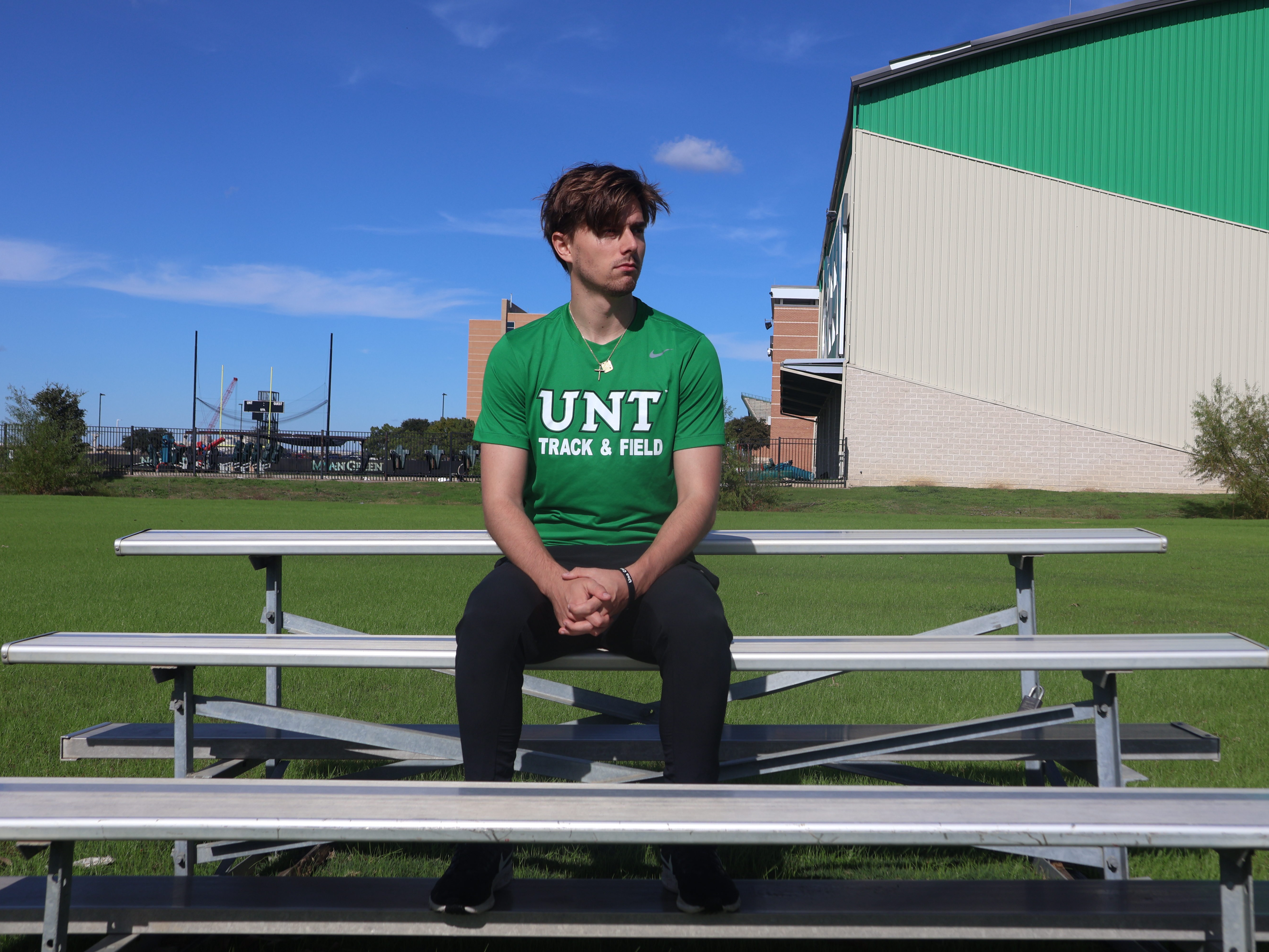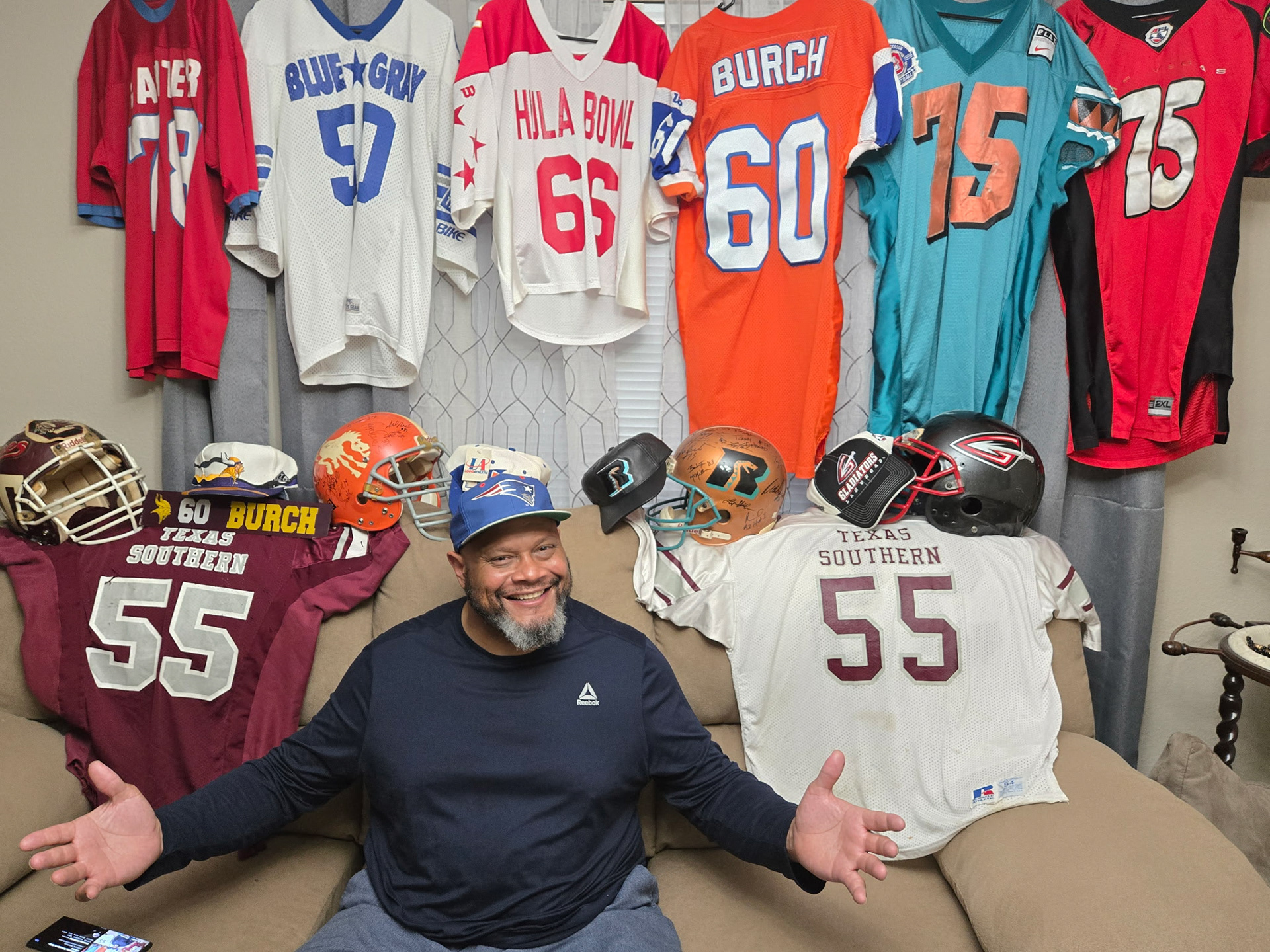
Joe Burch sits down with his professional and college football gear. Tara Burch
When former NFL and Arena Football League player Joe Burch looks back at his football career, he doesn’t just remember the excitement of the game. He remembers the stress, pain, and pressure that came with it.
“My journey to the NFL, to me, was an accident,” Burch said, who played offensive and defensive lineman. “I was just trying to play my best at the college level. I didn’t even know scouts were looking at me.”
He said he never planned on becoming a professional football player. He was focused on playing well in college — until scouts began showing up at practice.
“That’s when I realized I might actually have a shot,” he said.
But once he got to the NFL, he realized football wasn’t just a sport — it was a business.
“You’re a pawn — honestly, a piece of meat,” Burch said. “The NFL Combine reminded me of a modern-day meat market. They measured everything — your body, your mind, your height. It felt like the slave trade.”
His schedule was punishing. Days were filled with meetings, film study, and long practices. Even on off days, injured players were required to wake up early before team meetings for treatment.
“You never really had a day off,” Burch said. (Burch is the author’s uncle by marriage.)
Sports psychology professional Briana Wallace notes that athletes experience a wide range of pressures, many of which mirror what players like Burch lived through. However, today the industry is more cognizant of the mental health challenges. These include depression, anxiety, trauma, and grief, while performance-related challenges include confidence issues, team cohesion, emotional regulation, and adapting to new environments. Mental health and performance concerns often overlap.
“If we emphasize mental toughness in sports, then we have to support the mental side just as much as the physical,” said Wallace, who also is a doctoral student at the University of North Texas.
Wallace said the most unrecognizable aspect of athlete mental health is the assumption that successful athletes “have it all together.”
“People assume they shouldn’t struggle,” she said. “But athletes are human. They face regular life challenges on top of intense pressure to perform. That’s often overlooked.”
Access to mental health professionals is critical, especially for high-level athletes under intense scrutiny and pressure. While older generations were told to “man up” and handle it alone, today’s athletes have more resources. Universities, particularly Division I programs, now provide sports psychologists, counseling partnerships, and mental health liaisons.
The pressures of professional football
Burch said the game was far more violent during his era. He was on the roster for the New England Patriots, Denver Broncos and Minnesota Vikings. He also played for the Connecticut Coyotes, Arizona Rattlers, Las Vegas Gladiators in the Arena Football League.
“Today’s game is much softer,” he said. “Back then, you could knock a receiver out cold, hit a man across the head, and it was all fair play.”
Injuries were routine. Broken bones, bruises — and even worse.
“One of my friends, Derek Stingley, got paralyzed from the neck down in a game — and that was a legal hit,” he said.
The physical pain was intense, but the mental stress was something players never spoke about.
“It was like a man code,” Burch said. “You kept everything inside. If you talked about feeling down or stressed, they’d just say, ‘Man, stop being soft.’ Mental health was not a topic at all.”
He remembers being yelled at by a coach for a mistake he did not make. When he stood up for himself, he was traded three weeks later.
“It’s a business,” he said. “That’s just how it worked.”
He further described having an anxiety attack without knowing what it was.
“I fell over after practice with pains in my gut,” he said. “Back then, nobody talked about stuff like that.”
A game that comes with a price
Although the culture has shifted and mental health is slowly becoming part of the conversation, players like Joe Burch still carry the trauma of a tougher, less forgiving era.
“It was a real job,” Burch said. “But it came with a price — physically and mentally.”
There are lots of effective coping strategies. One of the simplest and most powerful is breathing work, breathing exercises and meditation. Focusing on the breath helps athletes anchor themselves in the present moment and regain a sense of control.
Grounding techniques are also helpful. A common one is the “five senses” technique naming five things you see, four you can touch, three you can hear, two you can smell, and one you can taste. It helps reset the mind and relax the body.
And then there’s self-talk. How athletes speak to themselves is huge. Negative or unproductive self-talk increases stress. But using positive, supportive or productive self-talk can make a major difference in how they perform and how they handle pressure.
There’s a wide range of challenges for professional athletes and athletes in general experience. On the mental health side, this can include depression, anxiety, difficulty processing trauma, grief, or anything under that umbrella. Then there’s the performance side, which includes things like confidence issues, team cohesion, feeling connected or belonging on a team, or specific performance-related anxieties like struggling with a particular skill or becoming anxious while performing it.
It’s hard to pinpoint one universal concern because mental health and performance overlap so much. But overall, anxiety and depression are common, and performance concerns often revolve around emotional regulation, confidence, trust in teammates and coaches, and adjusting to an environment or system.
That used to be the reality, and to some extent still is. But over the years, especially as professional athletes have spoken publicly about mental health, society has become more open and accepting to addressing it.
Weight of the game
Burch played through one of the most punishing injuries of his career: a severely damaged big toe that would not heal without surgery.
”There was no way that was going to heal,” he said. “I played all the way through the playoffs. My big toe looked big and swollen as heck. I wore a side shoe too big and a steel plate under my foot so the toe area of my shoe wouldn’t bend.”
He didn’t even practice during the week, yet he pushed himself onto the field because he needed that championship.
By the Arena Bowl championship game, the numbness wore off. When the medical staff refused another injection, he could barely move.
“I said, ‘Y’all want to shoot me up again?’ And they said, ‘Oh, we cannot do that.’ The heck you mean? This is the last game, I'm here to win this ring!” He paused, voice breaking. “ I cried after that. People think I cried because we lost the game. I cried because we lost the game. I cried because, yes, we lost, but I did all this just to get this championship my foot up to get this ring, and y'all did not want to do it.”
The aftermath was brutal. He spent an entire year rehabbing the foot, relearning how to walk and run. When he was finally ready to come back, the team released him. The physical pain was unbearable, but the emotional toll fighting for a championship he would never get to hold left wounds far deeper than any injury.
For years, Joe Burch carried the weight of the game alone, the pressure , the fear, the expectations, the silence. Nobody talked about mental health. Nobody asked if he was okay. He just kept moving because that’s what the sport demanded.
But as Wallace explained, athletes aren't invincible. They hurt, they struggle, they break, and they heal just like anyone else.
Burch’s honesty now, after all these years, is more powerful than any play he ever made. By telling the truth about what he lived through, he gives voice to the pain so many athletes before and after him hide and that might be his most important contribution to the game.

Sharron Jordan is a Journalism student at the University of North Texas majoring in Photojournalism and a minor in social science. Sharron is set to graduate in Spring 2026 and plans to pursue firefighting in the near future and continue to run his own business as a Photographer in the DFW area.