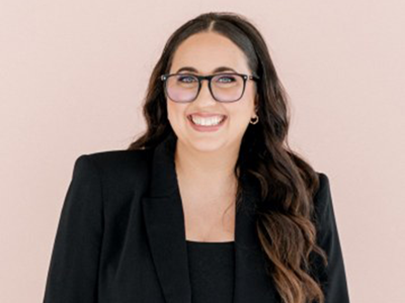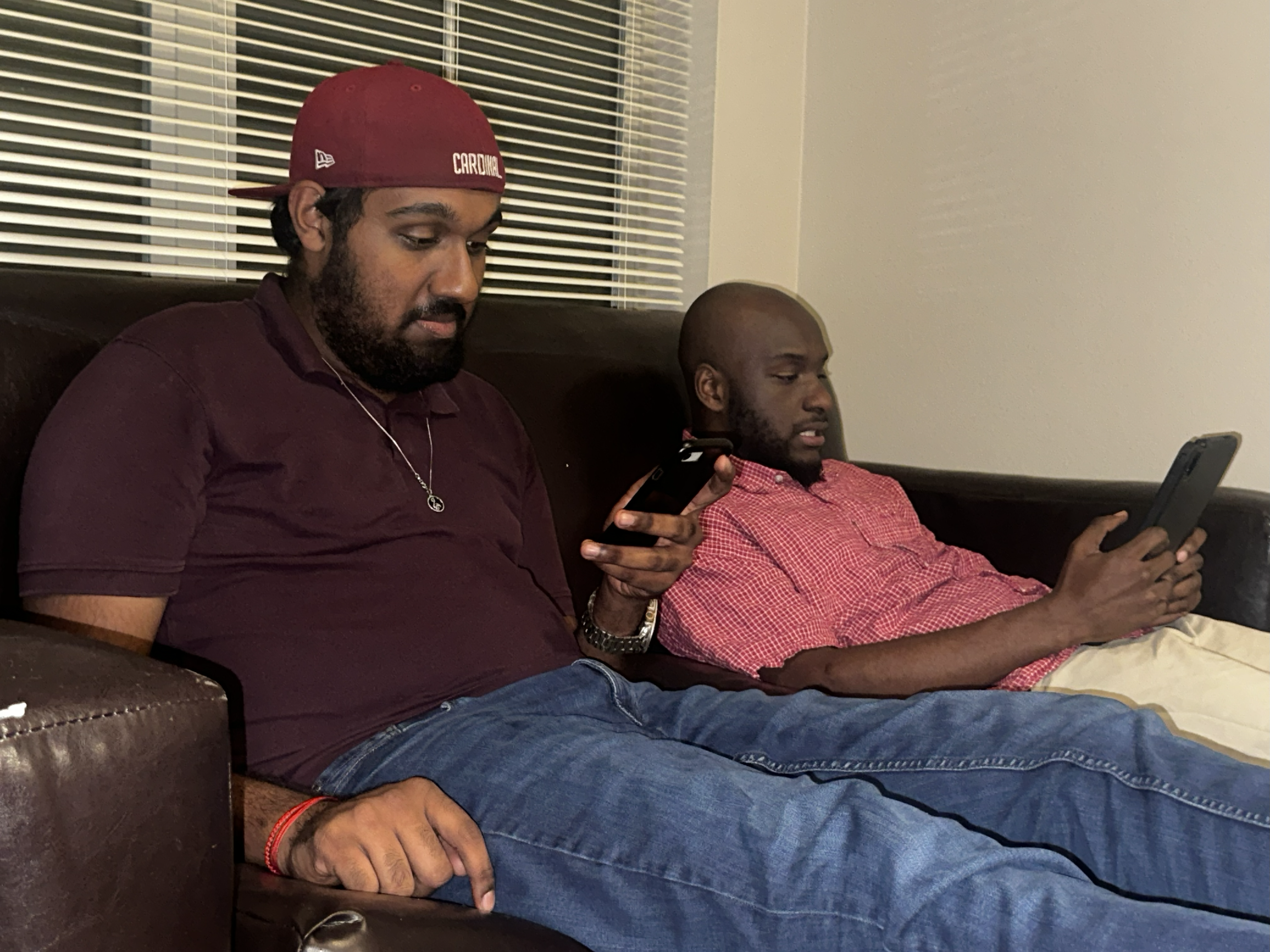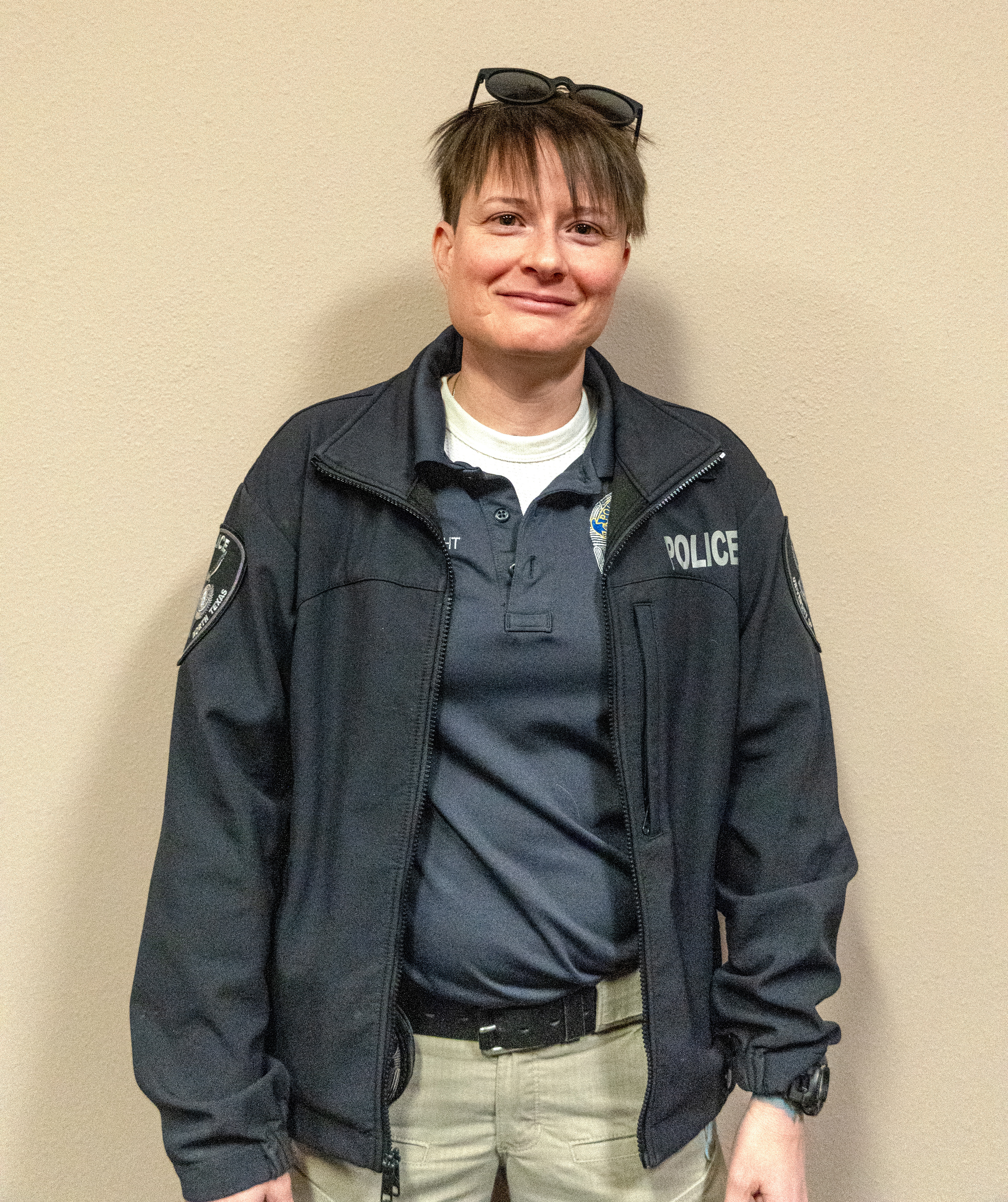
Officer Kimberly Wright of the University of North Texas Police Department wears a non-traditional uniform during crisis response calls to reduce intimidation and increase engagement. Tabitha Hidalgo
He sat at the edge of Lake Lewisville, staring at the water, prepared to end his life. His ex-girlfriend and friends had called police, afraid he would not make it home.
When a Lake Dallas officer reached him, the young man tossed his knife into the grass. Instead of shouting commands or reaching for force, the officer lowered himself into the sand beside the man and spoke quietly.
The man, who asked to remain anonymous, said he had gone to Willow Grove Park near Lake Lewisville in September 2023 to say goodbye to the people he loved.
He said the officer “immediately asked, ‘Hey, what’s going on?’ I threw the knife to the side and he told me not to worry about it.”
They sat together while the man explained how overwhelmed he felt. The officer then allowed his friends to bring him food and gave him privacy with each family member who arrived. Next, the officer explained he needed to take him to a mental health facility for evaluation.
“He said I’d have to ride in the back of the car, uncuffed, and he told me I could bring a friend,” the man said.
The officer took him to University Behavioral Health in Denton, where he received an evaluation.
Scenes like this – patient, present and grounded in human connection – represent one version of police response during a mental health emergency.
When someone is in crisis, a police officer may be the first, and sometimes the only, responder who determines whether a person ends up in a hospital, a jail cell or back home with or without support.
As mental health crises have increased across Texas, some agencies have attempted to change crisis response by pairing officers with mental-health professionals to prioritize treatment and safety.
The University of North Texas Police Department recently launched a Crisis Response Team for its first full semester in fall 2025, pairing a licensed clinical social worker with a trained officer to respond to mental-health calls. The team operates Monday through Friday from 10:30 a.m. to 6 p.m. and has averaged around 30 calls per month, according to Officer Kimberly Wright and clinician Amanda Fath, who works with police officers.
The partnership allows Fath, a social worker, to conduct on-scene assessments and de-escalation techniques while Wright ensures safety, distance and scene stability before a conversation occurs. Wright said most UNT PD officers also receive additional mental-health certification beyond what state law requires.
Wright said pairing officers with clinicians helps avoid escalation caused by rapid or force-driven entries into crisis scenes.
In the past, “some officers create the situation,” Wright said. “They escalate it themselves.”
Fath said Wright steps in when the risk is unclear before she begins assessment. Fath said grounding, distraction tools and tone-regulation are often embedded subtly in routine conversation.
“I may have them take deep breaths, move to a quieter room or use fidgets without making it feel like therapy,” Fath said.
People who interact with the team may be transported voluntarily to counseling services, community mental health providers or inpatient facilities in unmarked cars to reduce stigma and maintain anonymity. The team also avoids traditional police uniforms during crisis responses, which Wright said helps reduce intimidation and allows people to feel more comfortable engaging in assessment or transport.
“We’re not here to get people in trouble – that’s not our goal,” Wright said. “It’s to get them help.”
She said some students are frightened that others, including parents, will find out about their crisis.
“No, we’re there to get them immediate help,” she said.
Fath also follows up after transports and coordinates with UNT’s CARE Team, a multi-department case management group that coordinates academic, financial, behavioral and emotional support for students.
Wright said since the program began, the team has not used restraints during crisis response. The team hopes to expand staffing in future years so that a mental-health clinician is available 24 hours a day.
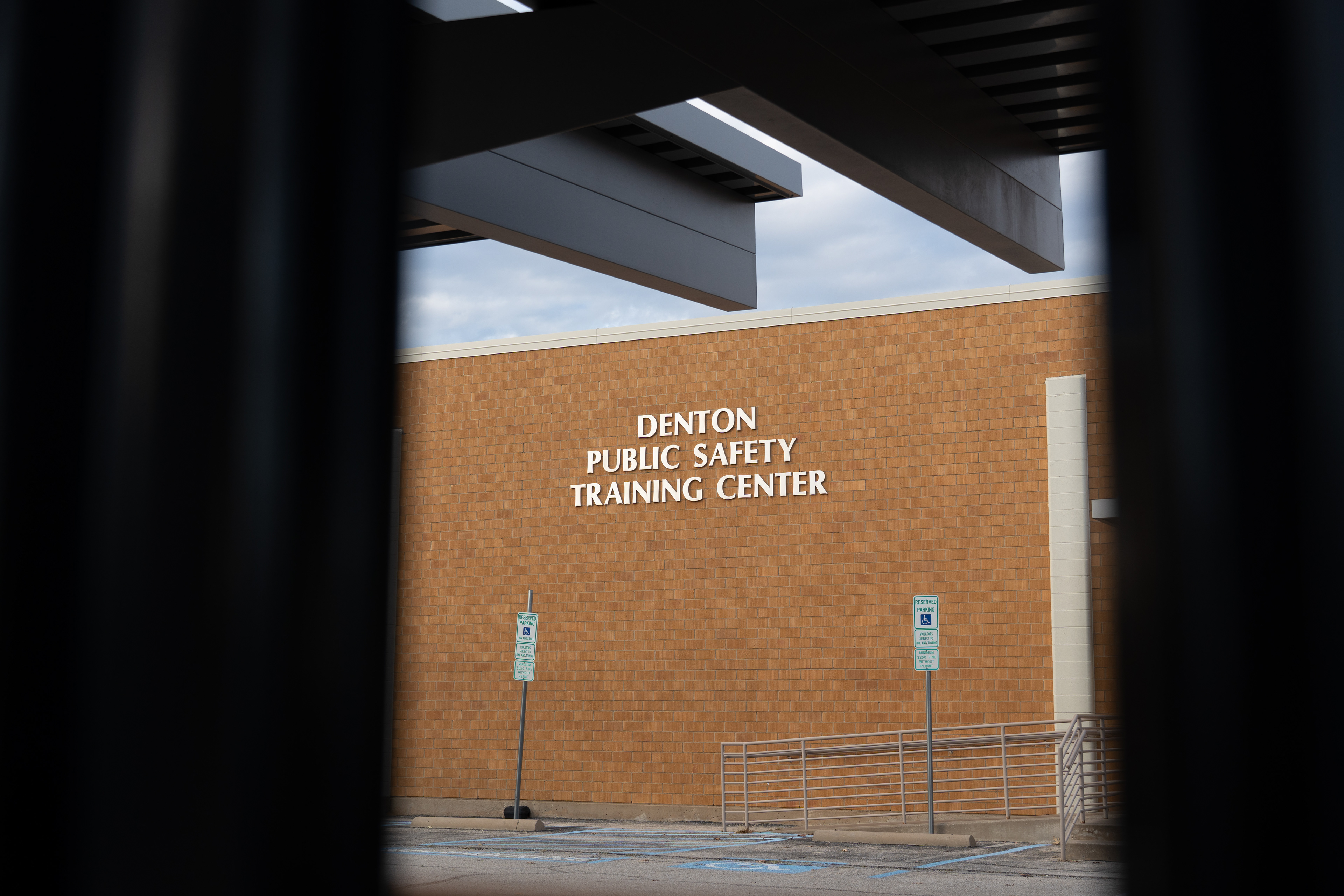
Denton Police Department’s Mental Health Division responded to 690 calls within its first two months of operation, according to the Denton Record-Chronicle. Tabitha Hidalgo
The Denton Police Department launched its Mental Health Division in 2021. Its partnership uses a similar model, by pairing trained officers with licensed clinicians who respond directly to people in distress. The Denton Record-Chronicle reported that the team responded to 690 calls within the first two months of operation.
“The goal is to connect individuals with the resources they need rather than making arrests,” said Lt. Scott Miller of Denton PD. “We want to provide a calming, de-escalating response.”
Before the division was formed, Denton officers responded to several high-profile mental-health calls that raised questions about training, de-escalation and available resources.
One of the most scrutinized was the 2020 shooting of Darius “DJ” Tarver, a 23-year-old University of North Texas student who was killed after police said he confronted officers with a frying pan and a meat cleaver during a mental-health episode. The shooting drew widespread criticism and sparked a series of vigils — including one held three years later in 2023 where community members renewed calls for police accountability and mental-health reform.
Darius’ father, Kevin Tarver, has continued advocating for systemic change.
“Part of my mission is telling my son’s story as we also continue the fight for his justice and change as well,” Tarver said.
His organization, The Darius Jerrell Tarver Justice Network, describes its work as “a movement, not a reaction,” focused on unity, public education and policy change. It aims to build coalitions with local and national partners, bring recommendations to police departments, push for legislative reform and promote accountability across the criminal justice system.
These municipal and campus programs show how clinical partnerships can reduce force and improve safety, but access remains inconsistent across Texas.
Dean, who asked to be identified only by his first name, recalled a crisis he experienced in 2019 in a Plano parking lot. He was 20 at the time and in early recovery from substance use. Police arrived after someone reported Dean’s erratic behavior. He said officers approached aggressively, ordered him out of his car and searched both him and the vehicle.
“When I finally calmed down and explained what was happening, they laughed and made jokes,” he said.
He said officers did not offer referrals or follow-up support.
“I wish there had been training and empathy,” he said. “They are supposed to be public protectors.”
Another North Texas resident, Chloe Noorani, said a mental-health episode she experienced led not to support, but to criminal charges.
Noorani, now a student at the University of Texas at Dallas, said she was arrested in 2024 after sending harassing emails to a professor at Texas Woman’s University who declined to write her a letter of recommendation. At the time, she was working two full-time jobs and participating in research projects — and a week later following her arrest learned she had untreated depression.
“I got emotional and sent rude emails. It was my fault for how I reacted,” Noorani said. “But I never expected the police to get involved.”
She spent about 30 hours in jail on a misdemeanor charge she is hoping is dismissed. Officers treated her professionally, she said, but she received no mental-health follow-up. The experience left her with financial burdens and trauma from being in custody.
Her experience reflects a broader issue: without a robust mental-health system, behavior tied to emotional distress can be interpreted as criminal rather than clinical.
National data helps illustrate how often police respond to behavioral-health emergencies. According to a Washington Post police shooting database analysis, since 2015, 168 people in Texas have been fatally shot by police in cases involving signs of mental illness, with the most recent occurring in December 2024 in Desoto. Every Texas case in the dataset included indicators of a mental-health condition, underscoring how often police become the default responders during mental-health crises.
Texas ranks among the lowest in the nation for access to mental health care, with high unmet treatment needs, according to Mental Health America’s 2025 State of Mental Health Report. The report places Texas near the bottom nationally for adults who are unable to access mental-health treatment due to provider shortages, insurance limitations and system barriers.
The report warns that inadequate state-level data collection has made it difficult to track need, evaluate policy impact or identify gaps in service. It noted that more states than previous years were excluded from the 2025 rankings due to insufficient reporting, limiting policymakers ability to target resources “to populations at greatest risk or to assess the impact of policy or programming changes.”
Experts say the state’s mental-health capacity problems compound the issue. According to the Texas Department of State Health Services, the state had roughly 242 mental-health providers per 100,000 residents in 2019 — a count that includes licensed professional counselors, psychologists, clinical social workers and other credentialed professionals – but availability varies widely across communities.
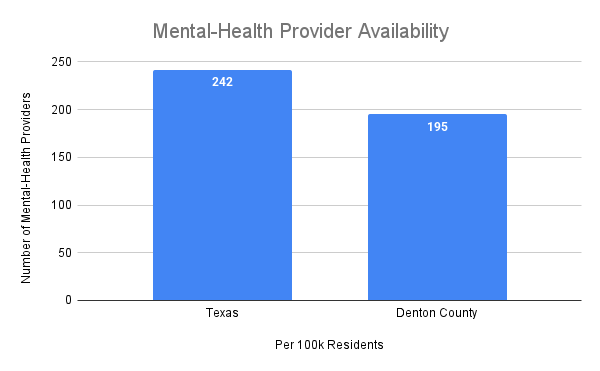
Mental-health provider availability in Denton County (195 providers per 100,000 residents) falls below the Texas statewide average (242 per 100,000), according to Healthy North Texas and the Texas Department of State Health Services. Tabitha Hidalgo
Fifteen Texas counties had no mental-health providers at all, and 222 counties fell below the statewide average, according to the agency. The Texas Tribune reported in 2024 that more than 80 percent of Texas counties are designated mental health professional shortage areas, meaning most Texans live in communities where provider supply is critically limited.
According to Healthy North Texas, Denton County has a mental-health provider rate of 195 clinicians per 100,000 population – a figure that reflects measurable supply constraints but does not capture whether clinicians are taking new patients, accept insurance or provide specialized care. The local dashboard also shows measurable mental-health burden as well, with North Texans experiencing 14 or more mentally unhealthy days in a month, a standard public-health measure of frequent mental distress.
Tracking these shortages is complicated by outdated or suppressed datasets and inconsistent state-level reporting.
An officer on a crisis intervention team from a North Texas police department, who requested anonymity because he is not authorized to speak publicly, said crisis calls vary widely.
“No call is ever the same,” he said. “It can be someone who is depressed and missed work or someone experiencing psychosis who has a weapon. You have to adjust every time.”
His agency uses negotiation teams, drones for communication and authority under Texas law that allows officers to place someone into protective custody when they pose a danger to themselves or others. He often follows up with individuals and their families after calls to maintain lines of support.
“You might get off a three-hour domestic violence call and then go straight into a mental-health crisis,” he said. “You’re exhausted — but you still have to try to give your best.”
He said in his experience burnout develops when officers repeatedly respond to the same individuals cycling through emergency rooms and treatment centers. He believes many people misunderstand the role police are expected to play.
“We are not mental-health professionals,” he said. “We can help stabilize someone in the moment, but we cannot provide long-term treatment. We’re a temporary solution.”
He said he wants to see more crisis-intervention training, more specialized teams with on-call clinicians, additional non-lethal tools and more opportunities for officers to engage with mental-health consumers outside of crisis moments.
“When we only see someone at their worst, it becomes easier to assume the worst,” he said.
As for the man at Lake Lewisville who is now 23, he does not remember the officer’s name. But he remembers the calm, the patience and the chance it gave him.
“He sat in the sand next to me and talked to me like a person,” he said. “If he had come at me aggressive or cold, I don’t think things would have gone well. I wish more people in crisis could have that kind of response.”

Tabitha Hidalgo is a senior at the University of North Texas studying journalism with a minor in Addiction Studies. She has been on staff at the North Texas Daily since transferring to UNT in fall 2024, and held the role of editor-in-chief in summer 2025. The South Texas native has also interned at KERA in Dallas for the Think talk show. After graduation, Hidalgo plans to find a job reporting on courts and the criminal justice system.