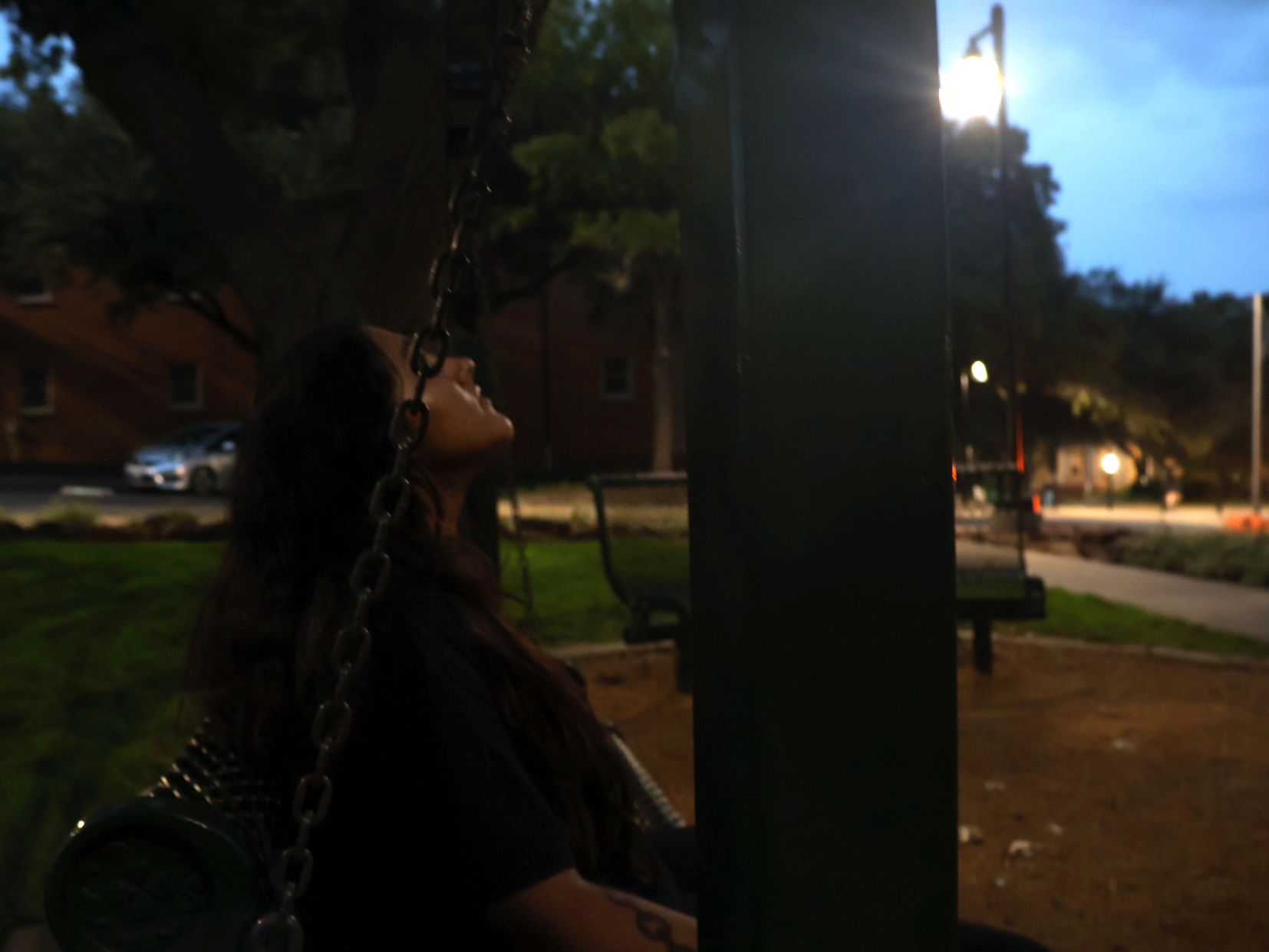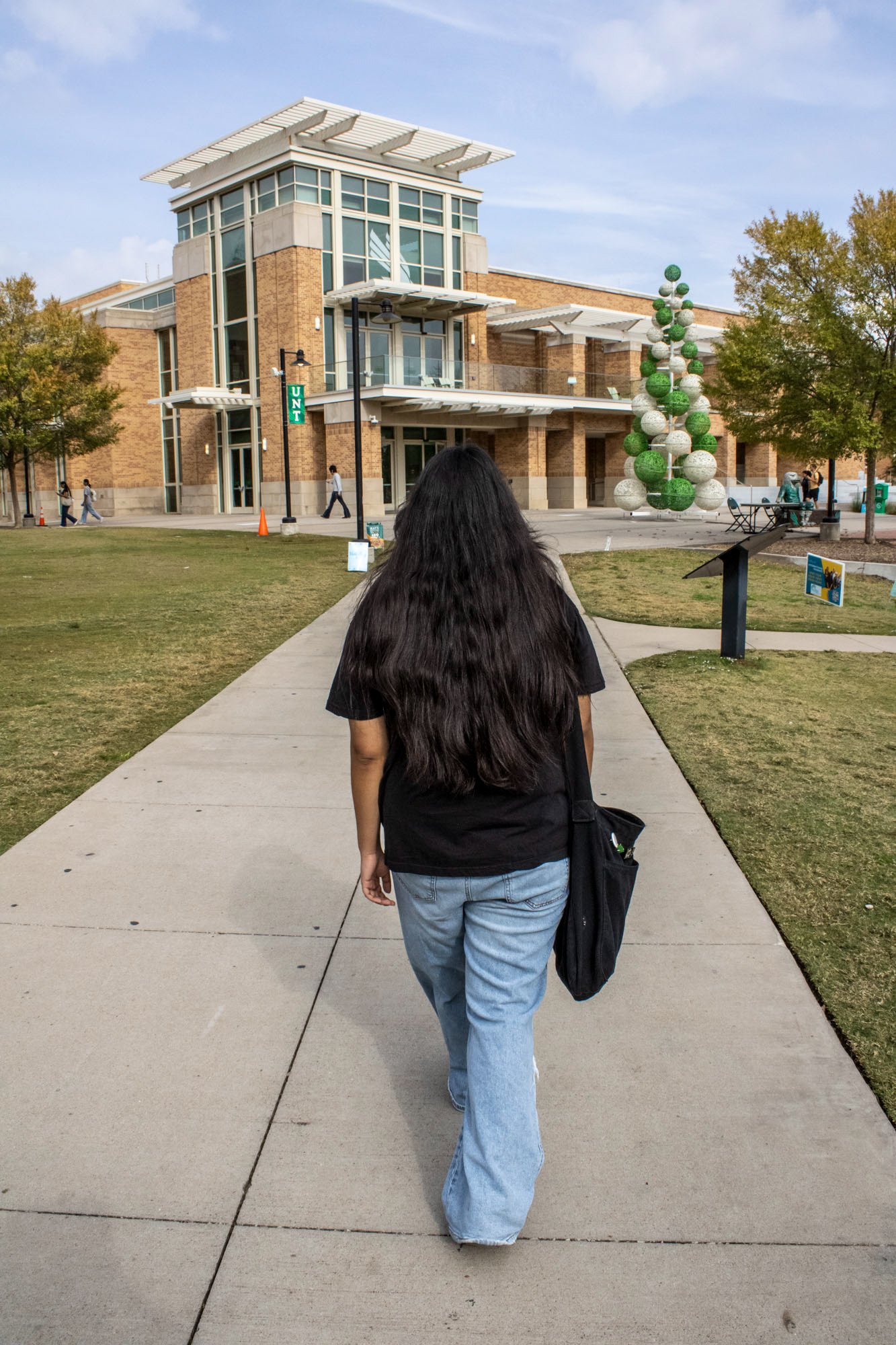
Student, Jazzlyn Hernandez, 18, walks to class at the University of North Texas. Alyssa Askue
For college students in the United States, the transition to higher education is often guided by emotional encouragement and financial help from parents. But as tuition costs rise and basic needs become harder to meet, students struggle to succeed while self-supporting. As a result of the ever-climbing cost of living, a growing number of students are losing their safety net.
Dalia Chowdhury, a rehabilitation psychologist and UNT professor who has spent decades working with addiction, trauma, suicide intervention, and a critical focus on youth mental health, said students who navigate college without reliable parental support must surmount hurdles others do not.
Students from low-income families face unrelenting pressures, Chowdhury said. She credits this to a growing divide between what students need and what many families can provide.
“Parents are overwhelmed … and one person only has so much energy,” Chowdhury said. “We used to see parents working one or two jobs to stay afloat, now we’re seeing three to four. The definition of work-life has changed.”
Third-year student, Jazzlyn Hernandez, 18, described the challenges she faced throughout her first months on campus.
“I thought I had enough money saved ... no I did not,” Hernandez said. “it’s just too expensive to stay here.”
For Hernandez, emotional and financial independence from her family has proven to be the most difficult aspect of college life. Moving from West, Texas, to UNT’s Sante Fe dorm hall left her roughly five hours from home and family.
“At times I regret moving so far away, but I know it was the right choice for me and my future,” Hernandez said. “I wouldn’t have the same opportunities at the community college back home.”
Although she has aunts who live nearby, the daily connection with her immediate family is what she misses most, especially her two younger sisters.
“I haven’t been home to see them since August,” Hernandez said. “We loved to catch up and gossip with each other. It's something we’d always do.”
The conflicting feelings of newfound independence and homesickness are common among college students, especially first-generation and out-of-town applicants.
Hernandez is the first to attend university in her family and credits her mom as her inspiration.
“It’s important for me to get this degree,” she said. “It will mean everything she’s done for me and all her hard work over the years will have paid off. My mom raised me hoping I would graduate and get a good job. To accomplish that would really be the fruits of her labor.”
While Hernandez has emotional support from her mother at a distance, full financial endorsement wasn’t a possibility when it came to financing her college experience.
“She tries to split costs with me when she can, but she has a family to take care of at the end of the day,” Hernandez said. “I don’t tend to ask her for much, so when I go out of my way it’s as a last resort. At that point she does what she can for me because she knows I must be fairly desperate.”

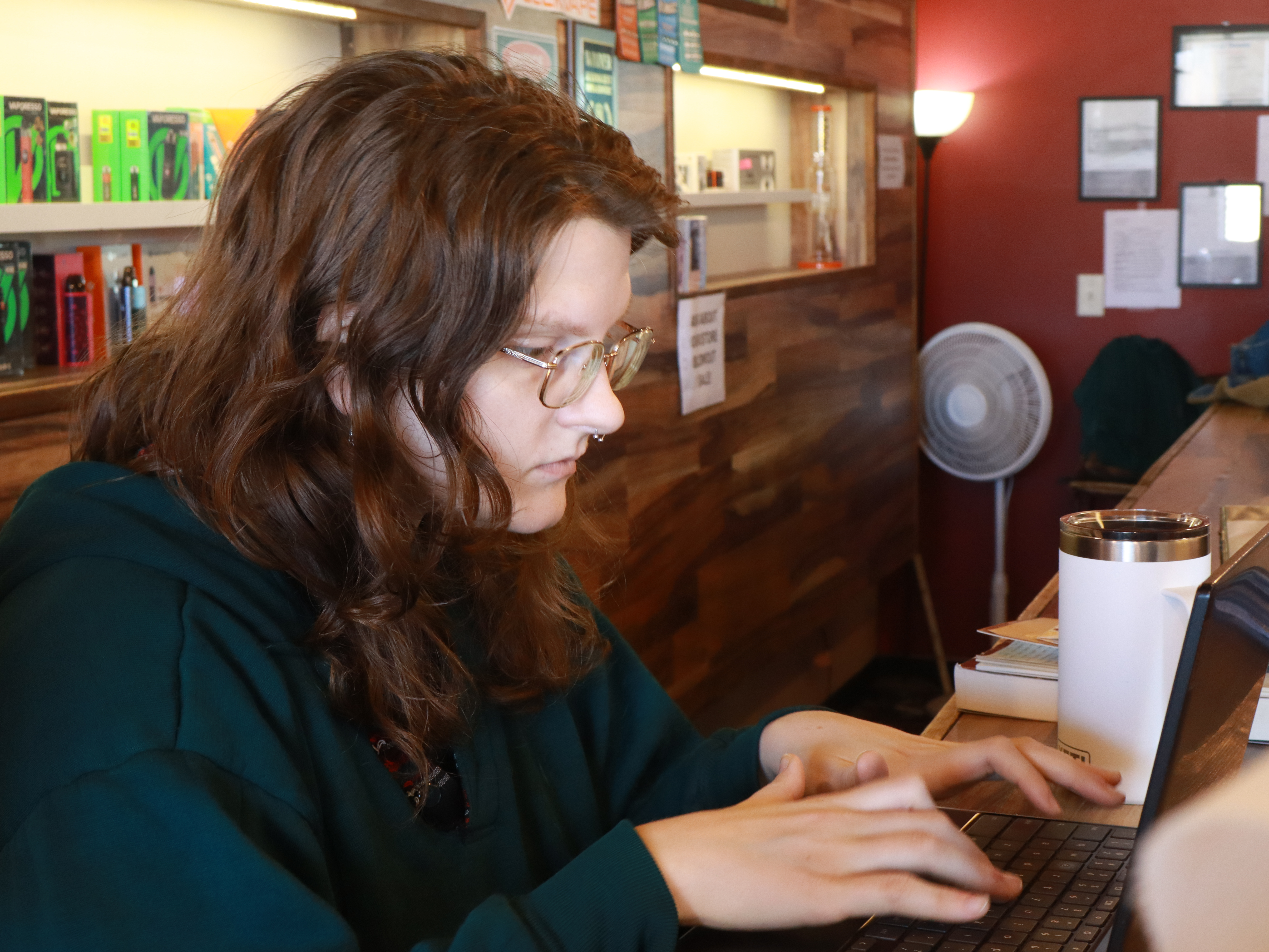
Third-year college student Jazzlyn Hernandez, 18, poses in the University of North Texas’ University Union. Alyssa Askue
After Hernandez realized her savings wouldn’t be enough, she began looking for a job in Denton. However, doing that proved to be difficult as campus opportunities dwindled.
“I realized I couldn’t live off of what I had, so I started scrolling for jobs on Handshake (UNT’s job listings for students),” she said. “I tried to find something on campus for weeks. I’d even apply as soon as the applications opened, always the same day. I triple checked that I met the requirements. Still nothing.”
Recently, she began working at the restaurant chain Panda Express. However, the change has been difficult to navigate.
“I’m grateful to be employed,” Hernandez said. “Before this was a constant worry and ‘oh my god, I can’t do this’ going through my head. It’s hard getting used to being away from home, then you add on classes and working. I’m only able to work one day a week, while taking my classes.”
While Hernandez struggles to finance college, she credits financial aid from the university as a way she stays afloat.
“I have two scholarships from UNT, Emerald Eagles and the Scrappy Excellence award,” Hernandez said. “I still pay fees out of pocket, but these take care of at least my tuition.”
This sentiment is growing in the population of college students as costs for private and public universities continue to climb.
Another UNT student, Jose Alcala, a second-year English major, finds these pressures eerily familiar.
After family upheaval led him to take on a supporting family role prematurely, Alcala struggled to grapple with his decision to leave home and create a new life.
“Initially I was not going to go to college,” Alcala said. “My dad wasn’t financially supporting us … my mom couldn’t get a job, and I had to take care of my little brother. I started working at Dominos just to make some money. It seemed like I couldn’t just leave them.”
The decision to pursue higher education marked a pivotal moment in his personal growth.
“Sometimes I feel like it was a selfish decision, but it’s what my mom wanted for me, and it’s what I wanted for myself,” Alcala said.
Balancing work and school has proved difficult, as he maintains a serving position at Olive Garden while taking a full course load.
“I usually work four to five days a week, sometimes doubling on the weekends … even then I often skip groceries some months after paying rent,” Alcala said.
Due to the higher costs of living and the greater amounts of time spent working, attention and stability at home is a struggle to maintain.
For those navigating higher education alone, the transition into independence can be especially jarring. Chowdhury explains the role this plays in students’ lives.
“There is no village that helps raise a child,” Chowdhury said. “It is very much the parents and the child, when parents get overwhelmed, there’s an obvious catch.”
She said students raised in these conditions experience higher levels of anxiety and uncertainty due to a lack of a steady support system. Financial strains only act to compound this emotional weight.
“There are students who come from genuine poverty … for those students they have to work multiple times harder in everything,” Chowdhury said. “They’re likely on scholarship, so there’s pressure to maintain certain grades … to have that top GPA.”
For students like Hernandez and Alcala, the lack of well-established support can lead to the compartmentalization of their stresses.
Alcala credits his friends and boyfriend for upholding him in times of need.
“A lot of support comes from them … but there are moments where I feel utterly alone. It’s hard watching friend talk to, or about their parents and knowing I can’t do that.”
Yet Alcala recognizes the strength he’s developed by enduring these challenges.
“I’m more independent than ever … being on my own has allowed me to fully express who I am. I felt like a little flower that was wilting … then I got here and it was like something clicked in my brain.”
A common barrier preventing students from seeking outside help is feelings of shame, or fear of being judged for their mental health. Others aren’t aware of the resources available to them and how they should access them.
“I try to keep my struggles separate from my friends and family,” Hernandez said. “When I’m feeling like it’s too much I hang out with my aunts on the weekend or go out with friends.”

Alyssa Askue is a freelance journalist based in the Dallas area. Her work has been published by the newspaper Denton Record Chronicle. She is currently completing her Bachelor of Arts in Photojournalism at the Mayborn School of Journalism. Askue plans to graduate with her degree in May of 2027, and plans to pursue a career in the field of photojournalism or photography.